 Stackyapper
Connect Microsoft Copilot Studio to Stackyapper.
Connect a Copilot Studio agent to Stackyapper, sign in securely, and test a read-only request with your existing workspace permissions.
To connect: Add https://mcp.stackyapper.dev/mcp. Enable generative orchestration, choose OAuth 2.0 Dynamic discovery, complete Microsoft sign-in and Stackyapper consent, bind the connection, then run a read-only test and confirm it in the activity map.
Copilot Studio connects using your existing Stackyapper workspace permissions. The agent only sees tools available to the signed-in user, and Stackyapper checks access again before every request.
What does Stackyapper make available?
Stackyapper gives Copilot Studio a focused set of tools based on the signed-in user’s access. Instead of loading every operation from every connected app, Copilot finds the right approved tool when it needs one. Before running it, Stackyapper checks the workspace, app, user and group permissions, risk controls, and approval requirements.
Before you start
- Permission to edit the target agent in Microsoft Copilot Studio.
- Generative orchestration enabled for that agent.
- An active Stackyapper workspace with one healthy app connection.
- Permission to use at least one read-only Stackyapper tool.
- Browser access to complete Microsoft sign-in and Stackyapper consent.
Connect Stackyapper with the MCP onboarding wizard
- Enable orchestration: open Settings → Generative AI → Orchestration, select Yes, and save.
- Open the wizard: go to Tools → Add a tool → New tool → Model Context Protocol.
- Describe the server: name it Stackyapper and explain that it searches and runs only the business-system operations this user is permitted to access.
- Enter the endpoint: use
https://mcp.stackyapper.dev/mcp. If your workspace already has a verified custom domain, use the endpoint shown in the Stackyapper portal. New custom domains require Business and approved MSP or consultant verification. - Configure authentication: select OAuth 2.0 → Dynamic discovery. Copilot Studio discovers the OAuth endpoints and dynamically registers; do not publish a client ID or secret.
- Authorize: complete Microsoft sign-in, confirm the intended workspace on the Stackyapper consent page, and approve.
- Bind the connection: select the connected Stackyapper account in the connection manager and save.
- Start fresh: open a new test session after changing the connection or orchestration mode.
These choices follow Microsoft’s official MCP onboarding and OAuth Dynamic discovery guide.
Choose the Copilot knowledge mode*
Web search is not required for the Stackyapper MCP connection. Choose it separately for each Copilot agent according to the customer’s policy for that Stackyapper workspace:
- Internal systems only: turn off Web Search on the agent’s Knowledge page. In Settings → Generative AI, also turn off Allow ungrounded responses to reduce answers produced without a configured tool or knowledge source.
- Internal systems plus public research: leave Web Search on. Copilot can combine public Bing results with Stackyapper results in the same answer.
Add this narrow instruction on the agent’s Overview page:
For business-system, customer, ticket, device, security, or internal
documentation requests, use Stackyapper. If Stackyapper returns no permitted
operation or no matching records, say so. Do not substitute public web results
or model knowledge and describe them as Stackyapper data.
Microsoft documents the agent-level Web Search setting, the limits of Allow ungrounded responses, and how to write and publish agent instructions.
*Copilot settings are managed by the customer and may also be restricted by Microsoft admin policies. They shape how Copilot finds information. Stackyapper workspace permissions still decide which tools and records the agent can use. Check the activity map and Stackyapper audit log to confirm when Stackyapper was used.
Test a read-only request
Using Stackyapper, find a read-only operation for [app] that can list [record type].
Return no more than five records. Do not create, update, delete, execute, or
otherwise change provider data.
Open the activity map and verify these three Stackyapper steps:
stackyapper_search_toolsfinds a tool the signed-in user can use.stackyapper_get_tool_schemasloads the information that tool needs.stackyapper_execute_read_toolchecks access again and runs the read-only request.
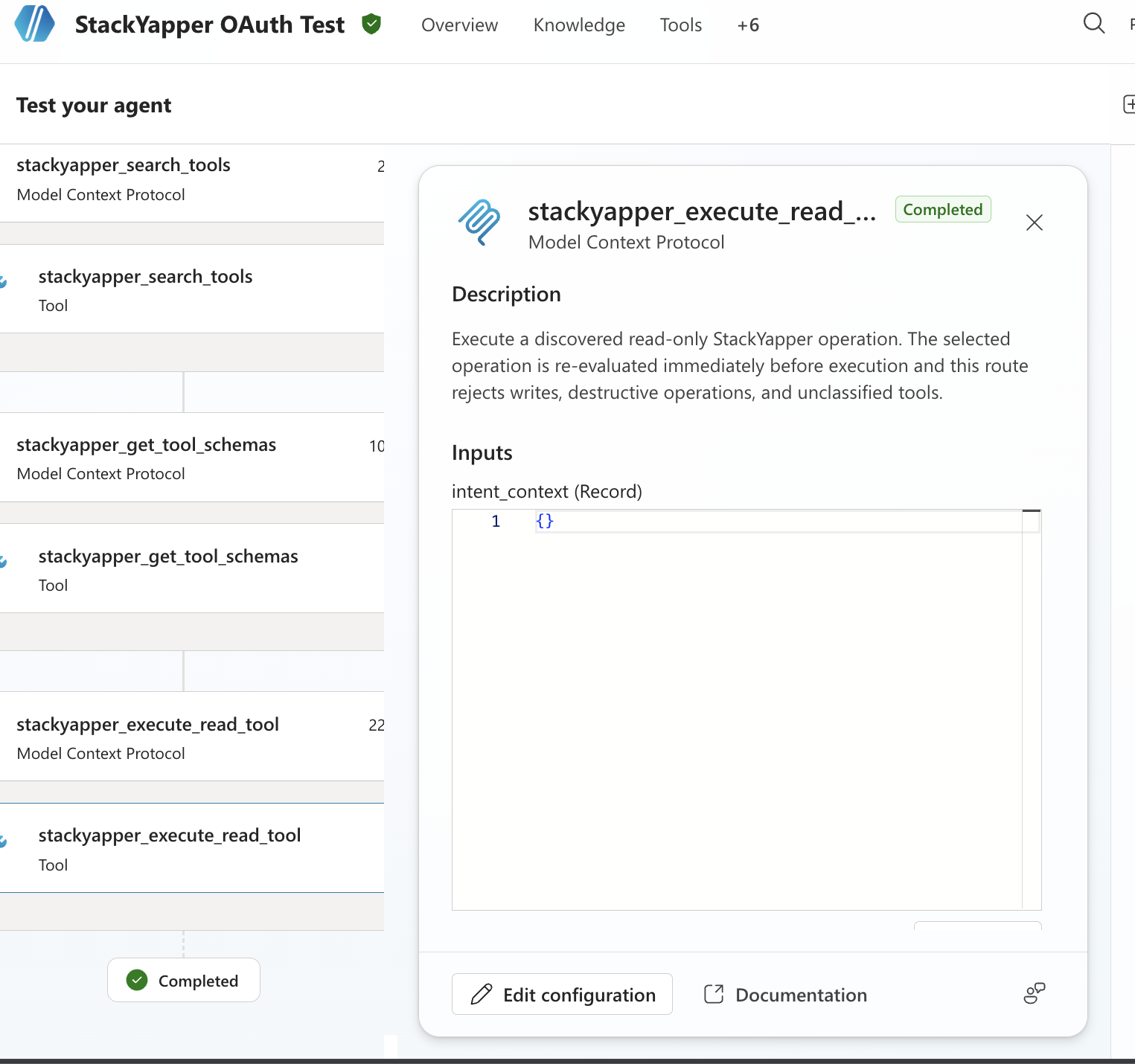
Microsoft’s activity-map guide explains how to inspect the selected plan, inputs, outputs, duration, and errors during testing.
Confirm the Stackyapper audit event
In the same Stackyapper workspace, open Audit and match the recent event by time, user, Copilot connection, app, action, result, and approximate duration. The audit log records how Stackyapper was used without storing the request details or data returned by the connected app.
Troubleshooting
| Result | Check |
|---|---|
| The server cannot be added | Confirm the /mcp endpoint and select OAuth 2.0 → Dynamic discovery. |
| Sign-in succeeds but the tool is unbound | Select the Stackyapper account in the connection manager, save, and start a fresh session. |
| No Stackyapper operation is selected | Confirm generative orchestration and use a specific server description and read-only request. |
| Search returns no operations | Ask an administrator to check app enablement and user or group grants. |
| The provider read fails | Repair the underlying app connection in Stackyapper, then repeat the read-only test. |
Continue with the general MCP client setup guide or review Stackyapper’s authorization model.